The Polycystic Ovary Syndrome (PCOS) is an endocrine-metabolic disorder that affects between 6% and 20% of women of reproductive age and is on the rise1,2.
Irregular or non-existent periods.
Presence of ovarian cysts.
Overweight or obesity.
Symptoms such as acne, increased hair or hair loss3.
These are some of the most characteristic symptoms of PCOS that many women of reproductive age present, without being aware of the metabolic and hormonal alterations behind them4,5. In addition, due to a sedentary lifestyle, diets high in processed foods, high levels of stress, and exposure to endocrine disruptors, the prevalence and severity of PCOS is increasing.
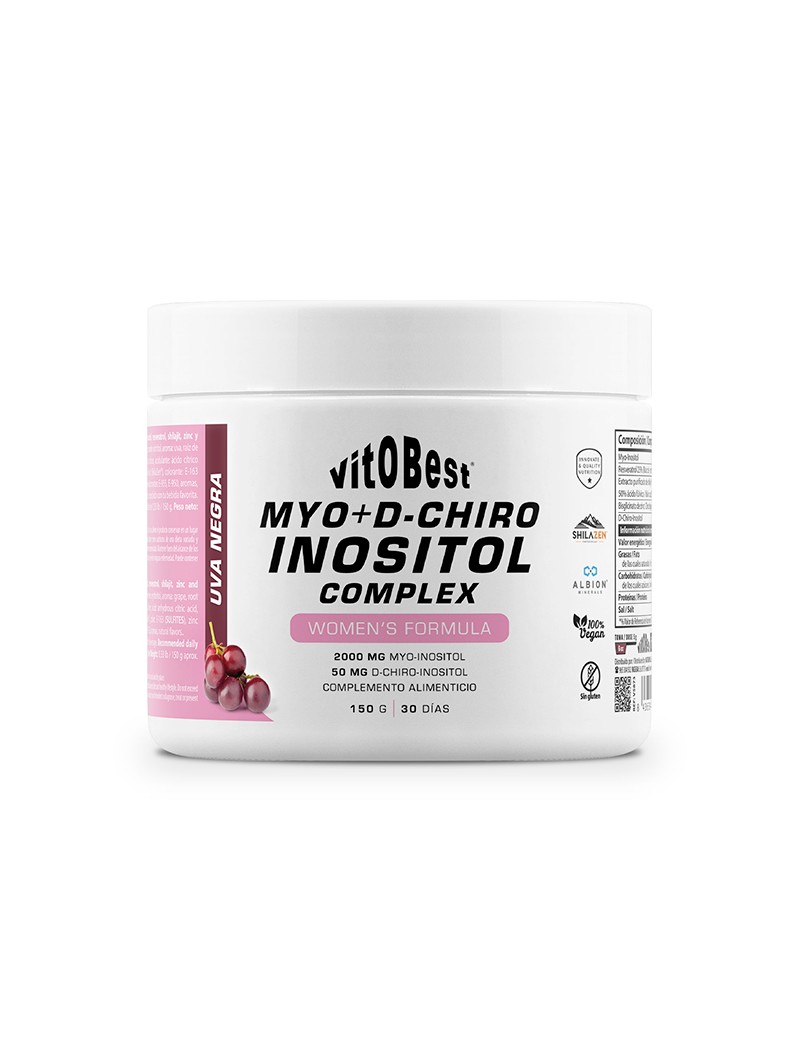
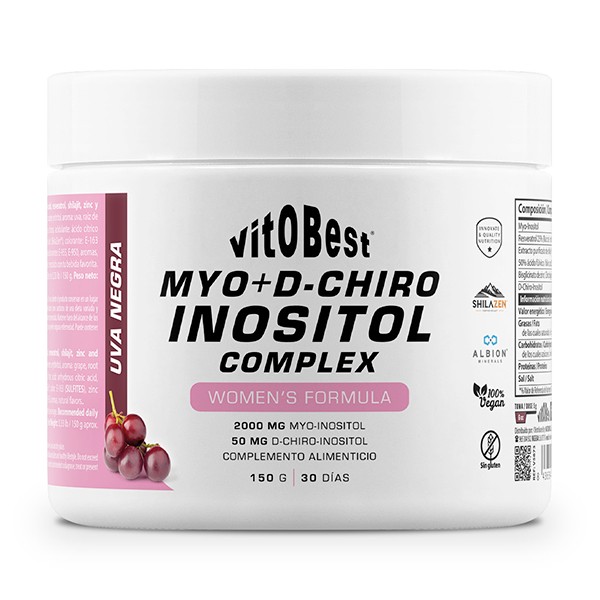
For this reason, Vitobest® has created Myo+D-Chiro Inositol Complex, a product specifically thought and formulated to provide our body with all the necessary tools to face PCOS and the symptoms it causes.
Myo+D-Chiro Inositol Complex, from Vitobest®, is a formula that combines the most advanced and effective natural active ingredients to help regain a hormonal and metabolic balance that PCOS has altered6:
Myo-Inositol: regulates insulin and promotes ovulation, helping to restore menstrual regularity and reduce PCOS symptoms7.
D-Chiro-Inositol: together with Myo-Inositol in an optimal ratio of 40:1, works synergistically to improve insulin sensitivity and reduce androgens, supporting metabolism and hormonal balance8.
Zinc Bisglycinate (Albion™): supports hormonal balance and reduces androgens to improve symptoms of hyperandrogenism; its chelated form ensures high absorption and prevents gastrointestinal effects9.
Shilajit (ShilaZen®, 50% fulvic acid): acts as an adaptogen and antioxidant to reduce stress and improve insulin sensitivity; ShilaZen® guarantees purity and safety10.
Resveratrol: anti-inflammatory and hormonal regulator that improves insulin sensitivity, reducing androgen production and PCOS symptoms11.
Balance your body and fight PCOS with the advanced natural formula of Myo+D-Chiro Inositol Complex, from Vitobest®!
Bibliography:
1Ding, T., Hardiman, P. J., Petersen, I., Wang, F. F., Qu, F., & Baio, G. (2017). The prevalence of polycystic ovary syndrome in reproductive-aged women of different ethnicity: a systematic review and meta-analysis. Oncotarget, 8(56), 96351. doi:10.18632/oncotarget.19180
2Azziz, R., Carmina, E., Chen, Z., Dunaif, A., Laven, J. S., Legro, R. S., & Yildiz, B. O. (2016). Polycystic ovary syndrome. Nature Reviews Disease Primers, 2(1), 1-18. doi:10.1038/nrdp.2016.57
3Fauser, B. C., Tarlatzis, B. C., Rebar, R. W., Legro, R. S., Balen, A. H., Lobo, R., ... & Boivin, J. (2012). Consensus on women's health aspects of polycystic ovary syndrome (PCOS): the Amsterdam ESHRE/ASRM‐Sponsored 3rd PCOS Consensus Workshop Group. Fertility and Sterility, 97(1), 28-38. doi:10.1016/j.fertnstert.2011.09.024
4Diamanti-Kandarakis, E., & Dunaif, A. (2012). Insulin resistance and the polycystic ovary syndrome revisited: an update on mechanisms and implications. Endocrine Reviews, 33(6), 981-1030. doi:10.1210/er.2011-1034
5Gibson-Helm, M., Teede, H., Dunaif, A., & Dokras, A. (2017). Delayed diagnosis and a lack of information associated with dissatisfaction in women with polycystic ovary syndrome. Journal of Clinical Endocrinology & Metabolism, 102(2), 604-612. doi:10.1210/jc.2016-2963
6Nestler, J. E., & Unfer, V. (2015). Reflections on inositol(s) for PCOS therapy: steps toward success. Gynecological Endocrinology, 31(7), 501-505. doi:10.3109/09513590.2015.1016186
7D'Anna, R., Santamaria, A., Cannata, M. L., Interdonato, M. L., Corrado, F., & Benedetto, A. D. (2007). Myo‐inositol supplement may improve oocyte quality in intracytoplasmic sperm injection cycles for PCOS women. European Review for Medical and Pharmacological Sciences, 11(6), 423-426.
8Isabella, R., & Raffone, E. (2012). Does ovary need D-chiro-inositol? Journal of Ovarian Research, 5(1), 14. doi:10.1186/1757-2215-5-14
9Hambidge, K. M., & Krebs, N. F. (2007). Zinc deficiency: a special challenge. Journal of Nutrition, 137(4), 1101-1105. doi:10.1093/jn/137.4.1101
10Schepdael, A., De Spiegeleer, B., & Braeken, E. (2008). The analysis and health benefits of shilajit. Journal of Natural Medicine, 62(4), 431-438. doi:10.1007/s11418-008-0251-6
11Vyas, N., Polotsky, A. J., & Smits, R. M. (2020). The role of antioxidants in the pathophysiology and treatment of polycystic ovary syndrome: A systematic review and meta-analysis. Fertility and Sterility, 113(6), 1370-1383. doi:10.1016/j.fertnstert.2020.02.129
Neutral: Take 2.87 g (1 level scoop) mixed with your favourite drink.
Flavours: Take 5 g (6 cc) mixed with your favourite drink.
WARNING: The products displayed here are nutritional supplements as defined by European Directive 2002/46/EC on food supplements. Food supplements are not intended to replace a balanced and varied diet; they are solely presented to complement the intake of nutrients in a normal diet. The information described about the ingredients may not be related to the final effect or benefits they may provide. They do not treat, prevent, diagnose, or cure any disease, as these are attributes of medicines, according to European Directive 2004/27/EC of 31 March, issued by the Council and the European Parliament on medicinal products. These products should not be used as a substitute for a diet or medication and must be kept out of reach of children.
The information and advice provided on this website are for informational purposes only. It is the User’s responsibility to consult a qualified doctor or nutritionist before starting any diet, training, or supplementation programme. The website owner assumes no responsibility for any potential damages or harm resulting from the use of the information contained on this website, nor for any misuse of the products offered through it.


-(Banner)_EN.jpg)
-(Banner).jpg)